
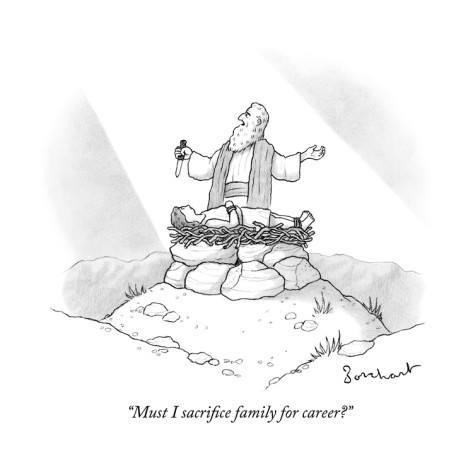
Every year, billions of humans celebrate a day, Eid ul Adha, to commemorate and celebrate the story of Abraham (Ibrahim) and his son, Ishmael (Ismaeel). However, I would like to address my concerns with this tale, or fallacy:
The common story goes that God asked Abraham to “sacrifice” his son. I respectfully submit that this would mean that God asked Abraham to “kill” his son. Isn’t sacrifice a fancy word for first degree murder? Let’s call a spade a spade: sacrifice = murder. How absurd that the most sublime God would encourage or instigate murder!
Chapter 10, verse 44 (Translated by Mohamed Saffie):
For certainty, neither does Allaah do harm, wrong nor injustice to any person, nor does HE enjoin them to harm, wrong or to be unjust to any. But it is people themselves who harm, wrong, and are unjust to themselves and others.
What was this potential murder for? What wrong did Abraham’s son do to deserve almost death? Traditionally, for some tribes in Arabia, if a female child was born, her father would bury her (alive). This horrific crime is tragic because the child did nothing wrong to deserve death, and further, which child deserves death anyways? Why did Abraham’s son deserve death? Is it okay to kill a minor for no reason according to the Qur’aan? Absolutely not.
Nowhere in the Qur’aan is this tale of sacrificing Ismaeel portrayed to mean a physical act of killing. There are better meanings for all the verbs mentioned. Anytime the meaning of verses leads to consequences and interpretations that diametrically oppose intelligence, logic, ethics, and the universal values and principles of goodness, then know that the meaning or interpretation is absurd and must be false. Those who seek sublime meanings will find them.
Chapter 37, verse 102 (Translated by Mohamed Saffie):
When he [Ismaeel] demonstrated that he was capable and responsible of meaningful actions, his mentor and father [Ibraheem] said to him: “O my offspring, whom I have raised and built with the empowering guidelines of Allaah’s social system, I have a plan for you but one which will require sacrifice, disadvantage and hardships. Think about it and let me know your decision.” He who was raised and cultivated with the value system of the Books of Allaah replied: “Please do whatever your plan requires you to do. You will find me steadfast, resolutely on the course of Allaah’s Guidance and fully expressive with all my capability.”
Should we follow in Abraham’s footsteps and attempt to kill our children? Which parent would do so?
Why would God ask one human to specifically try and kill another human? Does God play games with people? Why is justice not part of this picture?
Chapter 16, verse 60 (Translated by Mohamed Saffie):
Beyond any shadow of doubt, Allaah is Most just to humanity, enjoins justice to them, and instructs them to deal justly with one another; HE is the embodiment of kindness and goodness and instructs them to be kind to themselves and others, and to positively reach out to all who are nearby and accessible. Simultaneously, HE outlaws going beyond the established limits into immoderation and extremism, underrating the important matters of life, and therefore rationalizing aggression against one another. Allaah continuously exhorts you so that you will endeavour to be ever conscious of HIS Guidance to you.
Which human would allow another human to kill him for no reason? Is the sanctity and dignity of life not more important than any so called test? Don’t get me wrong, I love my parents, but maybe it’s just me, I’m not going to let them kill me. You might be different?!
Should humans encourage and celebrate attempted murder? Should it be a national holiday to commemorate attempted murder?
Should millions of animals be slaughtered in one day? How does that affect the ecosystem and environment? Does not the Qur’aan champion environmental rights and intelligence? Should we not encourage others to protect and enhance the life of animals rather than promote the opposite?
Would it not be more prudent if people bought a cow to gain its myriad benefits (milk, cheese, cream, butter, yogurt, kefir) rather than kill it and only obtain the meat that will be consumed in a couple of days or a few weeks?
Why give meat from the killed cow to the poor when we can teach the poor how to raise or farm a cow?
Synonyms for the word sacrifice include: Cede, drop, endure, eschew, forfeit, forgo, immolate, lose, offer, renounce, spare, suffer, surrender, waive, yield, kiss goodbye, offer up, part with, and resign oneself to
See the antonyms for sacrifice: continue, deny, disallow, fight, gain, keep, refuse, reject, win, withhold, holdBased on the above analysis and questions, it seems strange to partake in a celebration over an attempted first degree murder.
In fact, what Abraham had actually mentioned to his son, was that he envisioned that his future would be characterized by sacrifice through the tough society and environment they were residing in. Abraham taught Ismaeel that sacrifice was essential if Ismaeel was to excel in the future and achieve his goals. Hence, Ismaeel would have to become responsible and prepare himself for the challenges and sacrifices that lay ahead of him.
Ask anyone who has accomplished much in life, and they will always inform you that they had to sacrifice much too. Without sacrifice our dreams and goals are unattainable.
Whatever the dream, whatever the goal, there’s a price you’ll need to pay, and that means something you’ll need to give up.It may be something as simple as giving up a type of junk food you’re attached to, for the sake of your health; or something as subtle as giving up your right to be right, or your habit of exerting control over conversation for the sake of a relationship. It may mean postponing certain purchases or acquisitions, often called “delayed gratification,” or letting go of some pleasures for the sake of the pursuit of a longer-term aim. – Jeff Olson, The Slight Edge.
So what are you sacrificing every day in pursuit of your goals and dreams?
 Empowering Humanity